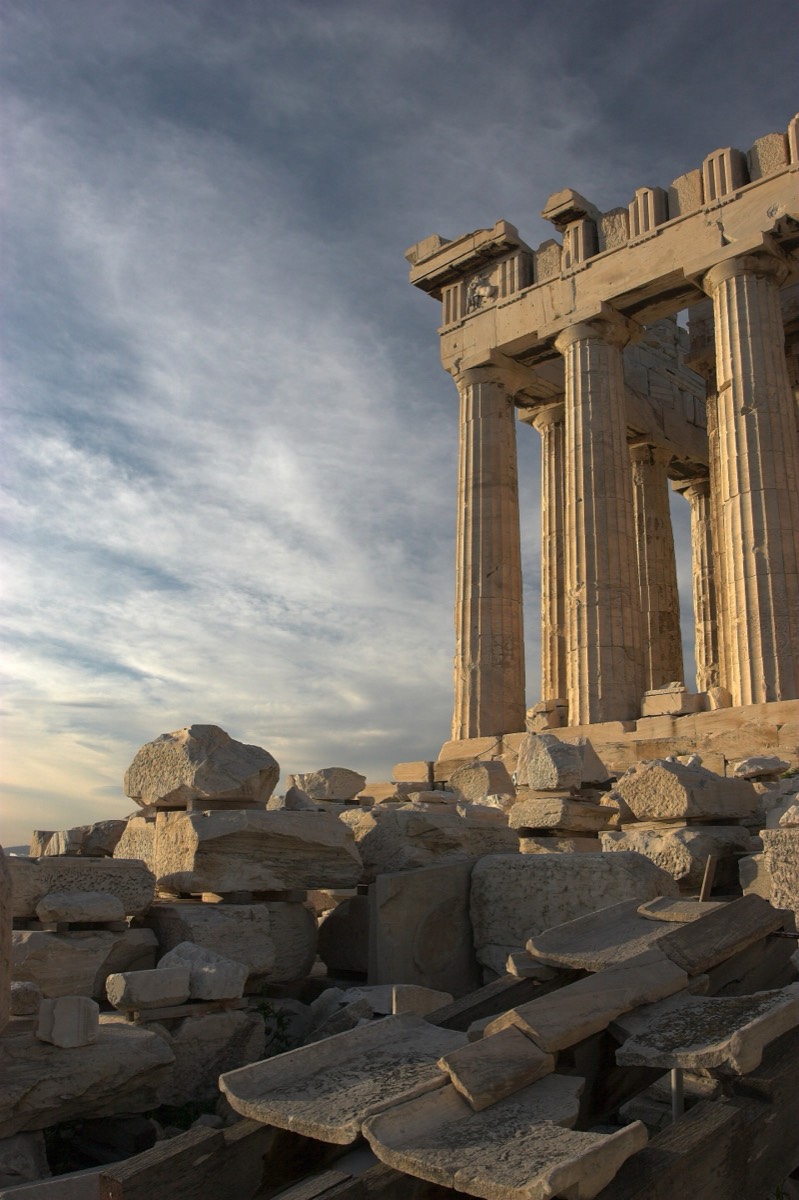
You're standing in front of the Parthenon. You see whiteness — bare stone, broken columns, empty niches. You raise your phone, and through the screen something impossible happens: the temple gets a roof, statues return to the pediments, the stone comes alive in colours that time washed out. For centuries, ancient temples looked painted, not white. CHRONOS shows you that where you stand.
CHRONOS is an augmented-reality app developed for the Athens Acropolis by the Greek telecom operator COSMOTE. A virtual guide named Clio leads the visitor through the space. Technically, the project was built around a 5G network — and that is exactly where the most important lesson for regional heritage hides.
The reconstruction isn't a video, it's a layer over reality. The app recognises what the camera sees and places a 3D model at the right point in space — the Parthenon with its roof, the statue of Athena where it once stood, colour on the frieze. The visitor moves the phone and the model moves with it, anchored into the real surroundings.
The AI guide Clio adds context the stone itself doesn't give: what was in this space, why it matters, how it was used. Instead of a static sign, the visitor gets an interlocutor who answers in the moment.
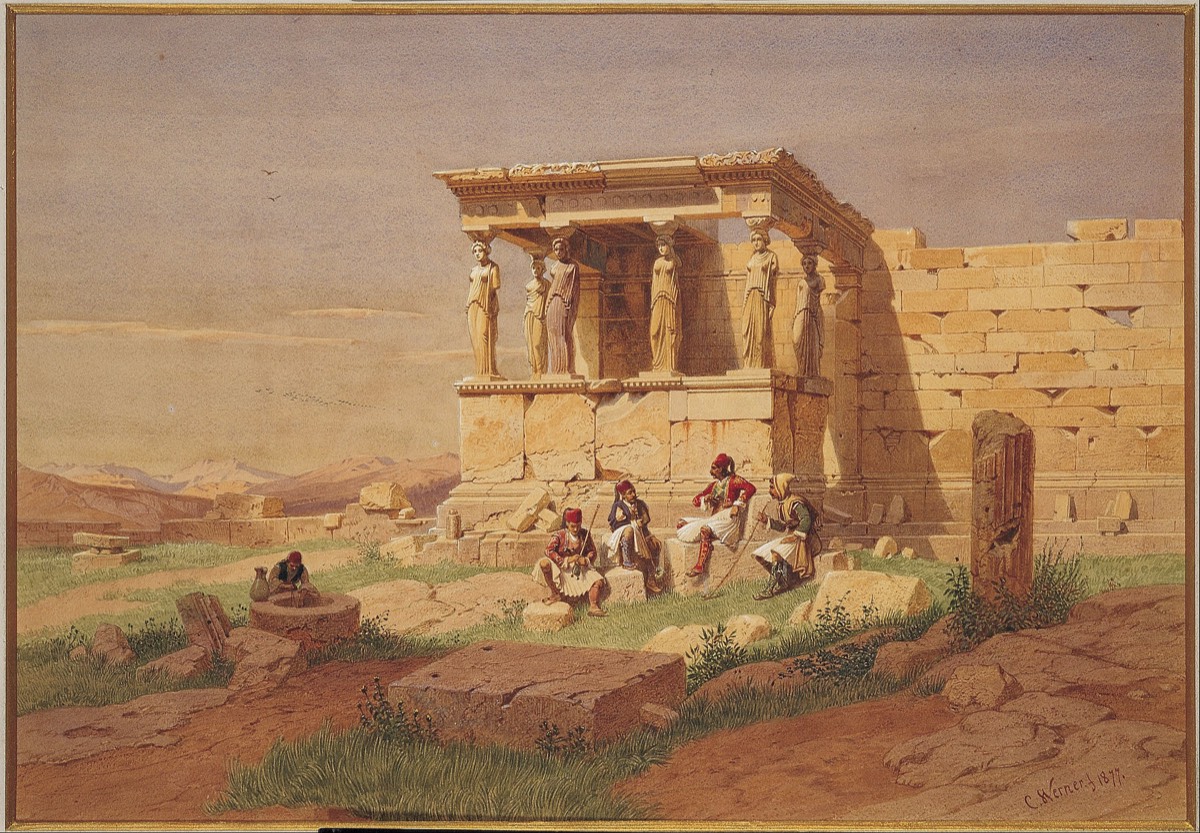
At its core is image-anchored AR — the app recognises features of the actual scene and pins a digital model to it, so the model stays in place as the visitor moves. This is technically harder than a floating 3D object; the model must be aligned with the real world.
CHRONOS was presented as a showcase of the operator's 5G capability. Heavy 3D models, high-resolution textures and on-the-fly content delivery need a fast, reliable connection — and 5G provides it at an open, well-covered site. That is both a strength and a weakness: the experience is excellent where 5G is, and doesn't work where it isn't.
The effect rests on three things. First, on-site reconstruction: you see the past exactly where it was, not on a separate screen. Second, colour and wholeness surprise: people remember antiquity as white, the painted version unsettles them and so they remember it. Third, the AI guide replaces the sign with a dialogue that adapts to the question.
Here's the inversion. CHRONOS's dependence on 5G is an advantage in Athens — and a problem at a Slovenian or Croatian castle. Thick stone walls, remote locations and dead network zones mean we can't rely on 5G. A solution that fails when the signal fails is not a solution.
Our approach flips the logic: AR and an AI guide that run locally on the device (on-device), with no dependence on the network. The 3D models and content load in advance at the entrance; the reconstruction and the conversation with the guide then work even deep inside a stone hall, where the phone hasn't a single bar. What is CHRONOS's weakness is, for a castle, the starting point.
And: the European Accessibility Act (EAA) has applied since June 2025. An AR experience must offer an alternative for visitors who can't use it — an audio description of the reconstruction, a text version of the guide, a clearly marked alternative path. Built in from the start.
Do we need 5G like CHRONOS? No — and that's the point. For a castle, an on-device approach that loads content in advance and runs without a network is more reliable and often cheaper.
Does AR work without internet? Yes, if it's designed that way. The models and guide load at the entrance and run locally on the device from there — essential for sites with dead zones.
How precisely is the model placed onto the real space? Image-anchored AR aligns the model with the actual scene; accuracy depends on preparing reference points and the lighting of the space.
How many languages for the guide? As standard, Slovenian, English, German, Italian and Croatian, with AI speech synthesis.
This study is part of the Museum AI playbook — 8 digital experience patterns that work.
Have a castle or archaeological site with no signal? That is exactly our terrain. Write to klemen@hopguides.art.