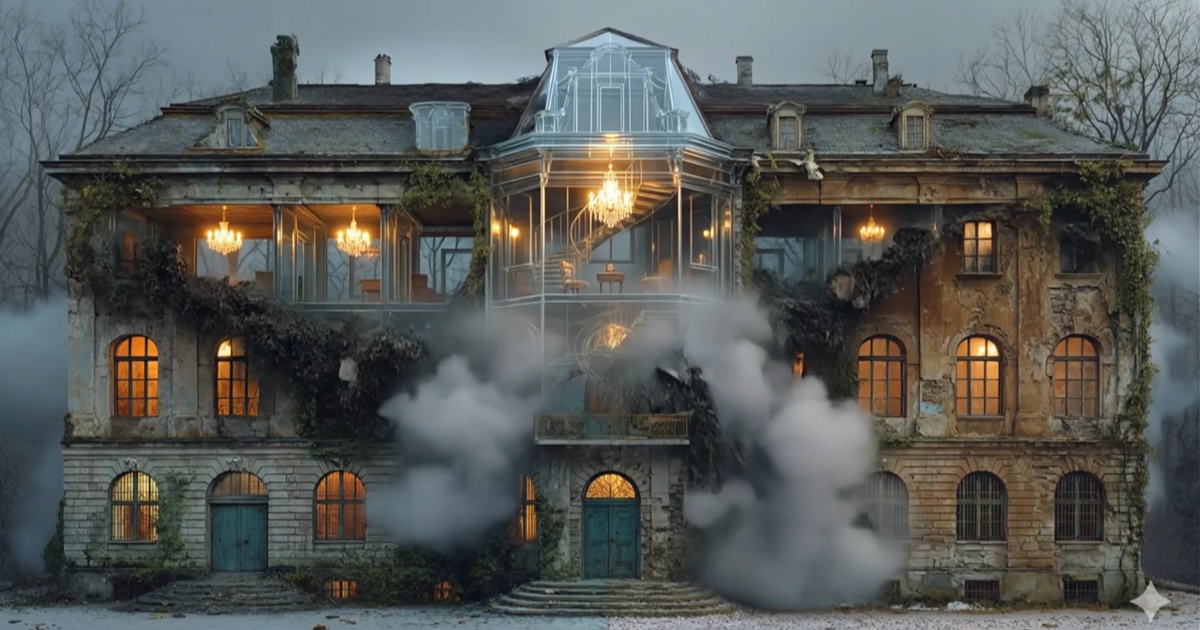
When a museum or castle first says "we need something digital", the conversation almost always starts with the technology: AR? An app? A touchscreen? Projection? That is the wrong first question. Technology dates in three years — the pattern of visitor behaviour, what draws people in, holds them and brings them back, does not.
Over the past year we have taken apart eight of the best museum digital projects in the world: from the Acropolis in augmented reality to a museum the visitor takes home. Beneath each technology sits a pattern that a regional museum or castle can reuse — even with a small team and none of the budget of the big institutions. These are those eight patterns, gathered in one place.
The most powerful use of augmented reality is not the effect, it is the restoration. COSMOTE CHRONOS on the Athens Acropolis uses the phone to bring back the colours, statues and buildings that are gone — the visitor stands before a ruin and sees the original. The lesson for a castle is direct: if you have an empty hall, a demolished wing or a lost interior, AR reconstruction beats any text panel. The only requirement is that it runs offline and does not depend on a mobile signal on site.
→ AR reconstruction: the Acropolis on your phone
Every app that has to be downloaded loses a large share of visitors before they even start — at the store, the update, the permissions. Met Unframed put the whole museum in the browser: one link, one click, the experience loads. No download, no sign-in. For a regional museum "no app" is almost always the right call — less maintenance, instant access and no needless friction between visitor and content.
→ No app: the whole museum in a browser
teamLab proved that digital content can be alive: a generative forest that constantly shifts and is never the same twice. That creates something a static exhibition cannot — a reason to return. A more modest build can use the same pattern: content that responds to the time of day, the season or the visitor feels fresh on every visit and extends the lifespan of the installation.
→ Generative experience: the forest that is never the same
Atelier des Lumières turned the hall into a canvas: paintings spill across the walls and floor through projection, and the visitor steps inside the artwork rather than standing in front of it. Immersion beats viewing. A castle or museum with a suitable space can achieve the same effect with a single well-considered projection — it need not be a whole hall, one room that surrounds the visitor is enough.
→ Immersive projection: when a painting becomes a room
ArtLens in Cleveland reversed the interaction: instead of the visitor looking at the artwork, the artwork recognises the visitor through AI and responds. That two-way exchange turns a passive viewer into a participant. For a museum it means a deeper connection and attention held for longer — a visitor addressed personally also remembers the content better.
→ AI interaction: when the artwork looks back at you
MONA removed the wall labels and replaced them with a device that guides the visitor through the collection on their own terms. The walls stay clean while the information is richer than ever — and in the language and depth the visitor chooses. The pattern is excellent for museums where wall panels spoil the display, or where you want content in five languages without five sets of stickers.
→ No labels: the museum with no captions
Cooper Hewitt gave the visitor a pen to collect exhibits during the visit and find them later on their own account at home. The connection with the museum does not end at the exit, it continues. Any museum can build in the same logic: the visitor saves what drew them in and gets a reason to come back — in person or online.
→ Take-home: the museum I carry home
The Rijksmuseum opened its high-resolution collection to everyone through Rijksstudio — works you can view, download and even remix from home. The museum reaches people who never cross the threshold while building future visitors who one day will. Even a smaller archive can have its own "heritage streaming": a well-digitised online collection is a lasting source of visits, not a cost.
→ Open collection: Netflix for heritage
You do not need all eight. Most museums start with one or two that best fit the collection and the budget, and grow from there. The sensible combinations are obvious: no-app WebAR (2) as the foundation, with AR reconstruction (1) layered onto one key hall; or an open collection (8) together with a take-home experience (7) for a museum with a rich archive.
The common thread across all eight patterns: they run on the phone the visitor already carries. That means no new hardware, no kiosks to maintain and no dependence on equipment that will not work in five years.
And accessibility is not an add-on. The European Accessibility Act (EAA) has applied since June 2025. Because all of these patterns run on the web, they can be built accessibly to WCAG 2.1 AA — screen reader, contrast, keyboard — if it is built in from the start and not bolted on at the end.
Which pattern is cheapest to start with? No app / WebAR (pattern 2). It needs no hardware and no two native apps to develop, and the visitor reaches the experience with a single click or a QR code at the entrance.
Do we need our own app? Almost never. For most museum cases a web experience (PWA or WebAR) delivers the same value without the install threshold and without maintaining two separate apps.
Does it work without the internet? Yes. The experience can be built as a PWA that loads on the first visit and then runs offline — important for stone halls and castles with dead zones.
How many languages? As standard Slovenian, English, German, Italian and Croatian, with AI speech synthesis.
Want to work out which of these patterns fits your museum or castle? Write to klemen@hopguides.art — let's talk.