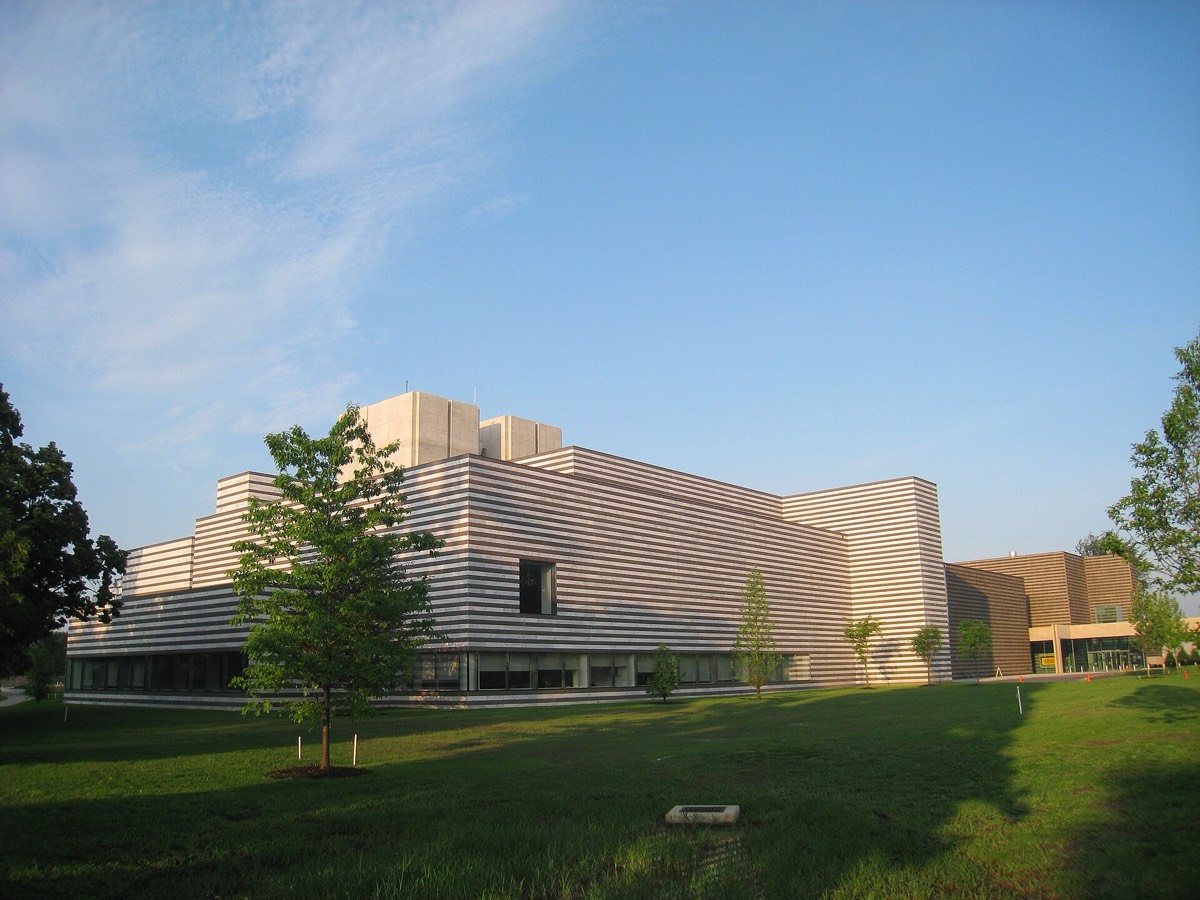
At the Cleveland Museum of Art you stand in front of a screen and the museum does something unusual — it looks back at you. In one ArtLens game you have to match a portrait's expression with your face; in another you take the same pose as a sculpture with your body. No typing, no touching. You move, the system detects the gesture, the artwork responds. The relationship between viewer and work inverts: you don't read about the art, you converse with it through movement.
The heart of this is ArtLens — a family of digital experiences the museum has developed since Gallery One opened in 2013. Its most recognisable element is the ArtLens Wall: a roughly 12-metre screen wall built from Christie MicroTiles display panels that shows every work currently on view, all at once.
The wall isn't a gallery sign, it's a living catalogue. You swipe across it with your fingers, filter by theme, period or type, and each object connects to what is actually hanging in the adjacent galleries. When you find something that draws you in, the wall points you to the original.
In the interactive gallery, looking becomes a game. The system senses body movement and gaze direction; the games ask you to match an expression, repeat a gesture, find a shape. A child who strikes the same pose as a Rodin will not forget that sculpture. The learning happens through the body, not through text.
The screen wall is based on modular Christie MicroTiles display panels, which allow a seamless large-format surface with high brightness and multitouch interaction. Behind it runs a system that ties content live to the collection on view — what's on the wall is also in the hall.
The interactive games use cameras and sensors to detect movement and gaze. And here is the most important engineering and legal decision: processing happens on the device, in real time, to drive the game's response — not to store anything. The system reacts to where you look now; it does not build a biometric profile that persists. This is not a side detail; it is what separates an experience like this from surveillance.
The effect rests on three things. First, no interface: no keyboard or menu, the body is the controller, which removes the barrier and the hygiene worry. Second, the game creates memory: playing something with your body is remembered differently than reading a sentence. Third, the wall connects digital to real: it doesn't replace the collection, it leads to it.
Gesture interaction appeals to a regional museum precisely because it removes touch — no smashed screens, no hygiene worry, no queue at a single device. Cleveland built at the top level with a 12-metre wall; a regional museum starts with one station and one gesture game tied to a single key exhibit.
The principle worth taking literally: on-device processing with no biometric retention. In a European context this isn't just good practice, it's a legal necessity. The General Data Protection Regulation (GDPR) treats biometric data with particular severity; an implementation that stores nothing and processes everything locally avoids the issue at the root, not with an extra consent form.
And: the European Accessibility Act (EAA) has applied since June 2025. A gesture game must have an alternative for visitors who can't perform the movement — a seated version, touch, or audio guidance. Inclusion is built in, not bolted on.
Does gaze tracking mean the museum is recording visitors? Done correctly, no. Processing runs on the device in real time to drive the game's response; nothing is stored or sent, which is consistent with GDPR.
Do we need a 12-metre wall? No. That is the top-tier example. A regional museum starts with one gesture station; the size grows with the hall and the budget.
Does it work without internet? Yes. Motion sensing and the game run locally on the device; connectivity is not a condition for operation.
How many languages for instructions and content? As standard, Slovenian, English, German, Italian and Croatian, with AI speech synthesis.
This study is part of the Museum AI playbook — 8 digital experience patterns that work.
Interested in a touch-free, surveillance-free gesture station? Write to klemen@hopguides.art — let's talk, no obligation.