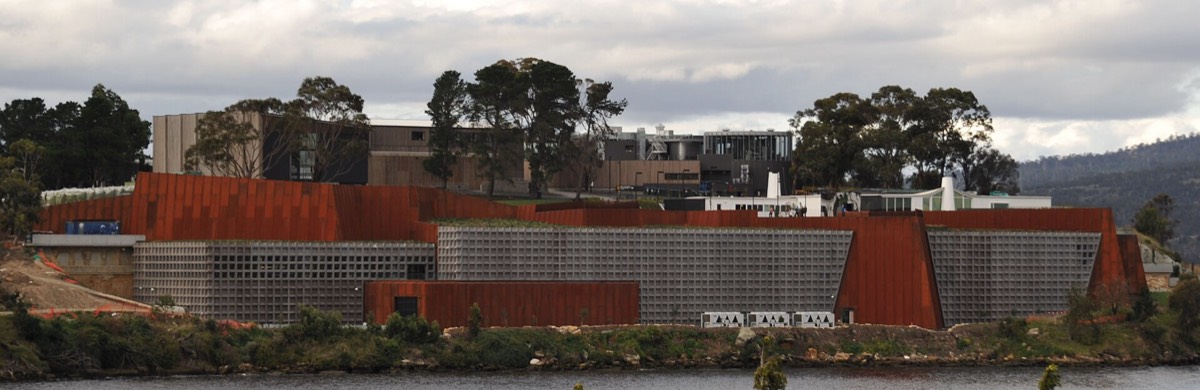
Picture a gallery carved deep into sandstone on the bank of the Derwent River in Tasmania. You step through a mirrored entrance, descend a spiral staircase into half-darkness — and notice something unsettling. The walls are bare. No captions. No dates. No plaques listing the artist and medium. Just the art, and you.
This is no oversight. This is MONA — the Museum of Old and New Art — Australia's most-visited private cultural attraction, and one of the most carefully considered digital museum experiences anywhere. Its founder, professional gambler David Walsh, set out to destroy what he calls "academic rhetoric" — the habit of visitors pressing their noses to the wall trying to decode dense scholarly text instead of actually looking at the art.
Instead of labels, every visitor receives a device called The O. And here's where it gets interesting: according to the studio that built it, over 97% of visitors use it — a figure essentially unheard of in the museum sector, where most apps fight for single-digit adoption. How did they pull it off?
The O knows roughly where you are. As you move through the dark, deliberately disorienting halls, it automatically lists the artworks nearest you — no typing codes, no scanning QR. Tap a work and layered content opens, split into tonally very different tiers: a short Summary, the tongue-in-cheek Art Wank (the deep curatorial perspective), Gonzo (cynical, personal takes, many written by Walsh himself), plus Ideas and Media with audio and video interviews.
Every work has two buttons: Love and Hate. You vote. And that vote shifts the power dynamic — Walsh built a space where the visitor's opinion counts as much as the director's. At the end, you can email yourself the entire walk and relive it at home.
Walsh has said publicly he'd happily open the museum with broken lighting or damaged paintings — but he'd never open the doors without The O.
First generation (2011). Each visitor got an iPod Touch in a custom enclosure with an active RFID tag. The ceilings were covered with sensors from Purelink — a commercial RTLS that fixed position using a mix of signal strength and time-of-flight, accurate to roughly three metres. A custom CMS plotted every artwork on a 2D floor plan with X/Y coordinates; data ran to an on-site server serving around 1,340 devices.
Second generation — "Enso Locate" (2012 onward). Art Processors — the studio that grew out of MONA itself — rewrote the system. Out went the ceiling RTLS sensors; in came Bluetooth LE beacons, configurable remotely via the CMS. This matters: beacons keep working when walls move, need minimal maintenance, and enable BYOD — visitors can use their own phones.
Tony Holzner, CEO of Art Processors, told Computerworld something worth hearing: developing the full software ecosystem that drives The O took four years of research and development. This was not an app. It was infrastructure.
97% adoption isn't a result of technology, but of three decisions technology merely enables. First, absence of choice as a feature: with no labels, there's no alternative — The O isn't an add-on to the visit, it is the visit. Second, layered content respects the visitor: one wants 20 seconds, another 20 minutes. Third, voting grants power and turns a spectator into a participant. The technology is invisible. That's precisely the point.
The good news: you don't need 75 million dollars for MONA's effect. You need the right architecture, scaled to a regional context.
Slovenian and Croatian castles are made of stone. Thick walls mean dead network zones where cellular and often Wi-Fi fail. MONA's original ceiling-RTLS solution is too expensive and overbuilt for a castle. The modern approach is BLE beacons for proximity sensing ("nearest artwork"), not full positioning. A beacon costs 15 to 30 euros, runs on battery for years, and — critically — works entirely without internet; content downloads in advance on entry and runs locally on the visitor's phone.
MONA started with 1,340 iPods. You don't need that. A progressive web app (PWA) that runs offline is cheaper for a regional museum, easier to maintain, and more hygienic. The layered-content model (Summary / Art Wank / Gonzo) is directly repeatable, and with AI speech synthesis, narration in Slovenian, English, German, Italian and Croatian becomes economically feasible even on a regional budget.
One thing can't be missing: the European Accessibility Act (EAA) has been in force since June 2025. Every digital experience must meet WCAG 2.1 AA — screen reader, audio description, adjustable type. Built in from the start, not bolted on at the end.
How much does such a solution cost for one museum or castle? A realistic range for a BYOD app with 20 to 40 BLE beacons, layered multilingual content and offline-first architecture runs between 35,000 and 80,000 euros, with annual maintenance around 6,000 to 12,000 euros.
Does it work without internet? Yes. Content downloads on entry and runs locally on the device — essential for stone castles with dead network zones.
Do visitors need a special device? No. By default they use their own phone (BYOD). Loaner tablets are added only if coverage is insufficient.
How many languages? Slovenian, English, German, Italian and Croatian as standard, with AI speech synthesis.
This study is part of the Museum AI playbook — 8 digital experience patterns that work.
Curious what's possible in your museum or castle? Write to klemen@hopguides.art — let's talk, no obligation.